

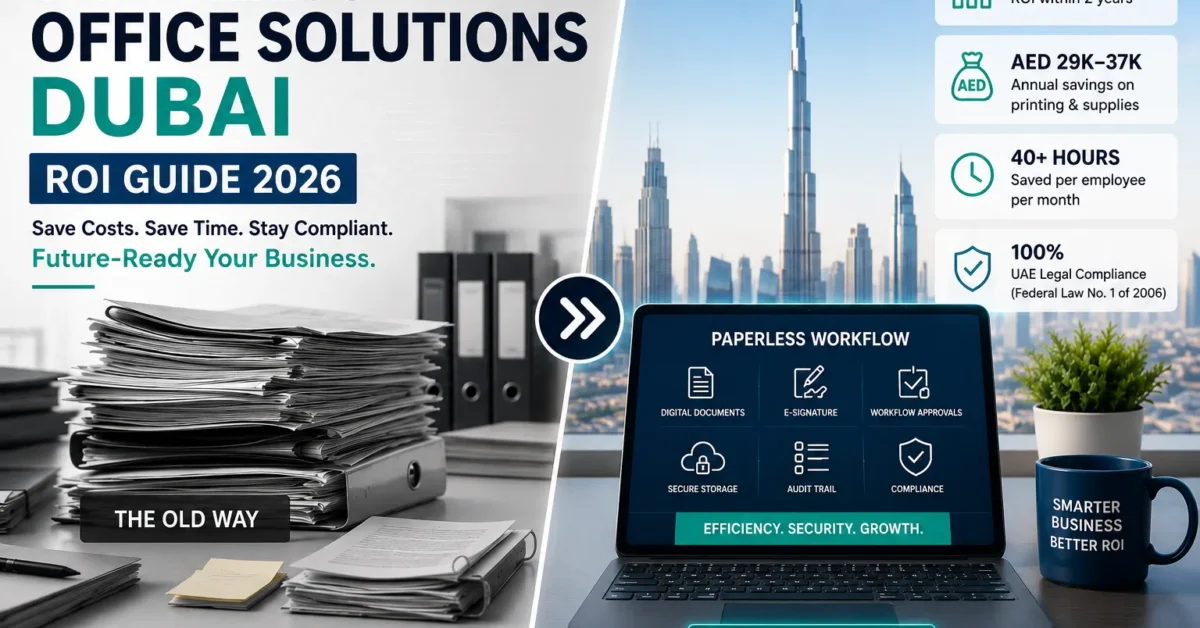
Many businesses in the UAE still rely on printed approvals, physical filing cabinets, and paper-based invoices. That gap is expensive.
The Dubai government eliminated paper transactions from all government entities by 2021. The private sector is the next frontier. Businesses that adopt paperless office solutions now are not just cutting costs — they are positioning themselves ahead of regulatory pressure that is already building.
This article breaks down the real numbers: what paperless office solutions cost in Dubai, what they return, and where the hidden value sits.
What Does "Paperless Office" Actually Mean for a Dubai Business?
A paperless office is a work environment where documents are created, stored, signed, shared, and archived digitally with zero dependency on physical paper at any stage of the workflow.
For a business in Dubai, this covers five operational areas. Document creation covers contracts, invoices, HR forms, and internal memos built in digital formats from the start. Electronic signatures are legally valid under UAE Federal Law No. 1 of 2006 on Electronic Commerce and Transactions. Cloud document management provides centralised storage with role-based access and full audit trails. Digital approvals replace manual sign-off chains through workflow automation. Paperless archiving converts physical filing systems into searchable digital records.
Dubai’s business community operates across real estate, finance, logistics, legal, and construction. All five sectors share one problem: high document volume and costly processing delays. A paperless system eliminates those delays at the infrastructure level, not just at the surface.
What Is the Real ROI of Going Paperless in the UAE?
Paperless office solutions in Dubai deliver an average ROI of 200–400% within two years. Most businesses reach positive ROI within 12–18 months of implementation.
Cost Category | Average Annual Saving |
Printing and supplies | AED 29,000–37,000 per firm |
Physical storage space | AED 7,350 per filing cabinet per year |
Invoice processing | 80% cost reduction |
Employee document handling labour | 40+ hours saved per employee per month |
Document retrieval time | 30% faster on average |
A 200-employee company processing 5,000 invoices annually eliminates tens of thousands in manual processing costs alone. Forrester Research benchmarks $21.50 saved per e-signed transaction. At volume, that figure compounds across every department.
AIIM — the Association for Intelligent Information Management — reports that the average organization sees ROI exceeding 400% from going paperless. That figure accounts for printing, storage, and labor cost reduction alongside workflow efficiency gains.
The payback period for most Dubai SMEs sits between 6 and 14 months.
How Does the Dubai Paperless Strategy Affect Private Businesses?
The Dubai Paperless Strategy mandated 100% paper-free transactions across all government entities by 2021. Private businesses are not legally required to comply, but those supplying government entities or operating in regulated sectors face increasing pressure to match digital standards.
The initiative was launched under Sheikh Mohammed bin Rashid Al Maktoum’s direction. Digital Dubai oversees the programms and awards a ‘100% Paperless Stamp’ to entities that fully implement it.
Three channels push this pressure into the private sector. Vendor compliance requires businesses supplying government entities to match their digital document standards. Regulatory alignment means future procurement and licensing workflows are being built for digital-first submission. Market expectation from clients and partners in regulated sectors treats paperless contracts and digital invoicing as default.
The UAE’s broader Vision 2031 agenda reinforces this direction. Sustainability reporting, ESG disclosure, and carbon footprint reduction targets all tie directly to reduced paper consumption. Businesses building paperless infrastructure now meet these expectations before they become regulatory requirements.
Which Dubai Business Sectors Gain the Most From Going Paperless?
Real estate, finance, logistics, HR, and legal operations gain the highest ROI from going paperless — because these sectors carry the heaviest document volume and the steepest processing costs per transaction.
The ROI varies by industry based on document volume and complexity.
Real estate in Dubai involves extensive documentation: NOCs, title deeds, lease agreements, and tenancy contracts. Digital document management cuts approval turnaround from days to hours. Dubai Land Department already accepts digital submissions as standard.
Finance and accounting operations are paper-heavy by nature. Switching to electronic invoicing alone saves up to 80% in processing costs. Digital records improve audit readiness and reduce FTA filing risk.
Logistics and supply chain businesses move shipping documents, customs declarations, and warehouse receipts across multiple parties simultaneously. Digital workflows eliminate delays caused by physical document transit between stakeholders.
HR and recruitment functions handle high volumes of offer letters, policy acknowledgements, onboarding documents, and payroll records. Paperless HR reduces employee onboarding time by 50% in most implementations.
Legal operations centre on contract management, NDA processing, and client documentation. Electronic signatures backed by UAE Federal Law make paperless contracting fully enforceable in UAE courts.
What Does Implementing Paperless Office Solutions Cost in Dubai?
A 50-person business in Dubai can expect to spend AED 55,000–110,000 in year one for full paperless implementation, including software, training, and legacy document digitalization. From year two, annual operating costs drop by 40–60%.
Implementation cost depends on business size, document volume, and the complexity of existing workflows.
Typical cost components break down as follows. Document management software runs AED 660–1,800 per user per year for enterprise platforms. E-signature tools cost AED 660–2,200 per user per year. Cloud storage infrastructure runs AED 1,100–5,500 per month for mid-sized businesses. Staff training is a one-time investment of AED 3,700–11,000. Legacy document digitalization costs AED 0.37–1.47 per page for scanning and OCR conversion.
Against this, the same 50-person business typically recovers AED 147,000–220,000 annually through eliminated printing, storage, and labor costs.
The numbers favor action. Year-one implementation costs are recovered entirely within the first 6–14 months for most Dubai operations.
What Are the Compliance and Security Advantages for UAE Businesses?
Digital document systems give UAE businesses stronger legal standing, better audit readiness, and tighter data security than paper — with automatic compliance logging built into every transaction.
UAE Federal Law No. 1 of 2006 gives electronic records the same legal weight as paper documents, provided they meet authenticity and integrity standards. A properly implemented digital document system satisfies this by design.
The security advantages are structural. Role-based access controls replace physical lock-and-key. Immutable audit trails record every view, edit, and approval with timestamps. Encryption at rest and in transit protects sensitive contracts. Automated retention policies enforce regulatory compliance without manual oversight. Disaster recovery is immediate — no physical document is lost in a fire, flood, or office relocation.
Businesses handling personal data gain stronger UAE PDPL (Personal Data Protection Law) compliance. Digital systems log access automatically, making data subject requests faster and FTA audit responses cleaner. Physical documents offer none of these controls by default. Every paper-based system carries a compliance gap that a digital system closes on day one.
How to Calculate the ROI of Going Paperless for Your Dubai Business
ROI = (Total Annual Savings − Annual System Cost) ÷ Annual System Cost × 100. A 200–300%
ROI within two years is the industry benchmark for UAE businesses. High-volume operations often hit this in 12 months.
The calculation has four steps.
Step 1 — Baseline current paper costs. Add monthly paper and toner spend, physical storage rental, postage and courier costs for documents, and staff hours spent on printing, filing, and retrieving records.
Step 2 — Estimate labour cost. Count employees who handle documents regularly. Multiply their weekly document hours by their hourly rate, then multiply by 52. Labour is consistently the largest hidden cost in paper-based operations.
Step 3 — Project digital savings. Digital document management reduces paper costs by 90%, storage costs by 60–80%, and document handling labour by 40+ hours per employee per month.
Step 4 — Apply the formula. Subtract annual system cost from total annual savings. Divide by annual system cost. Multiply by 100. Anything above 100% means the system pays for itself and returns a profit in year one.
Many Dubai businesses with high document volume cross 200% ROI within 12 months of going live.
Conclusion
Dubai’s business environment rewards speed, compliance, and efficiency. Paper slows all three.
Businesses going paperless in the UAE save an average of AED 29,000–37,000 annually on printing and supplies alone. Document retrieval drops from minutes to seconds. Audit readiness improves by default. ROI lands between 200–400% within two years for most implementations.
The Dubai Paperless Strategy set the standard for government in 2021. The private sector is following not by choice, but by market pressure and vendor expectation.
Businesses that build paperless infrastructure now gain a cost advantage, a compliance advantage, and a speed advantage before the window for early adoption closes.
JachOOs Solutions designs and implements paperless office systems built specifically for UAE business environments covering document management, e-signature integration, workflow automation, and cloud archiving, with full alignment to UAE legal requirements.
Get a free paperless readiness consultation →
FAQs
Yes. UAE Federal Law No. 1 of 2006 on Electronic Commerce and Transactions gives electronic documents and signatures the same legal validity as paper equivalents. Digital contracts, invoices, and records are fully enforceable in UAE courts.
Small businesses complete the transition in 4–8 weeks. Mid-sized organisations typically take 3–6 months for full implementation, including legacy document digitisation and staff training.
A government initiative that mandated 100% digital, paper-free transactions across all Dubai government entities by 2021. Digital Dubai oversees the programme and awards a '100% Paperless Stamp' to fully compliant entities.
Common platforms include cloud-based document management systems, e-signature tools compliant with UAE law, workflow automation software, and ERP-connected digital archiving. JachOOs Solutions builds custom paperless systems tailored specifically to UAE business environments.
Yes. Digital records with automated audit trails make VAT filing faster and reduce the risk of missing documentation during Federal Tax Authority audits.


